
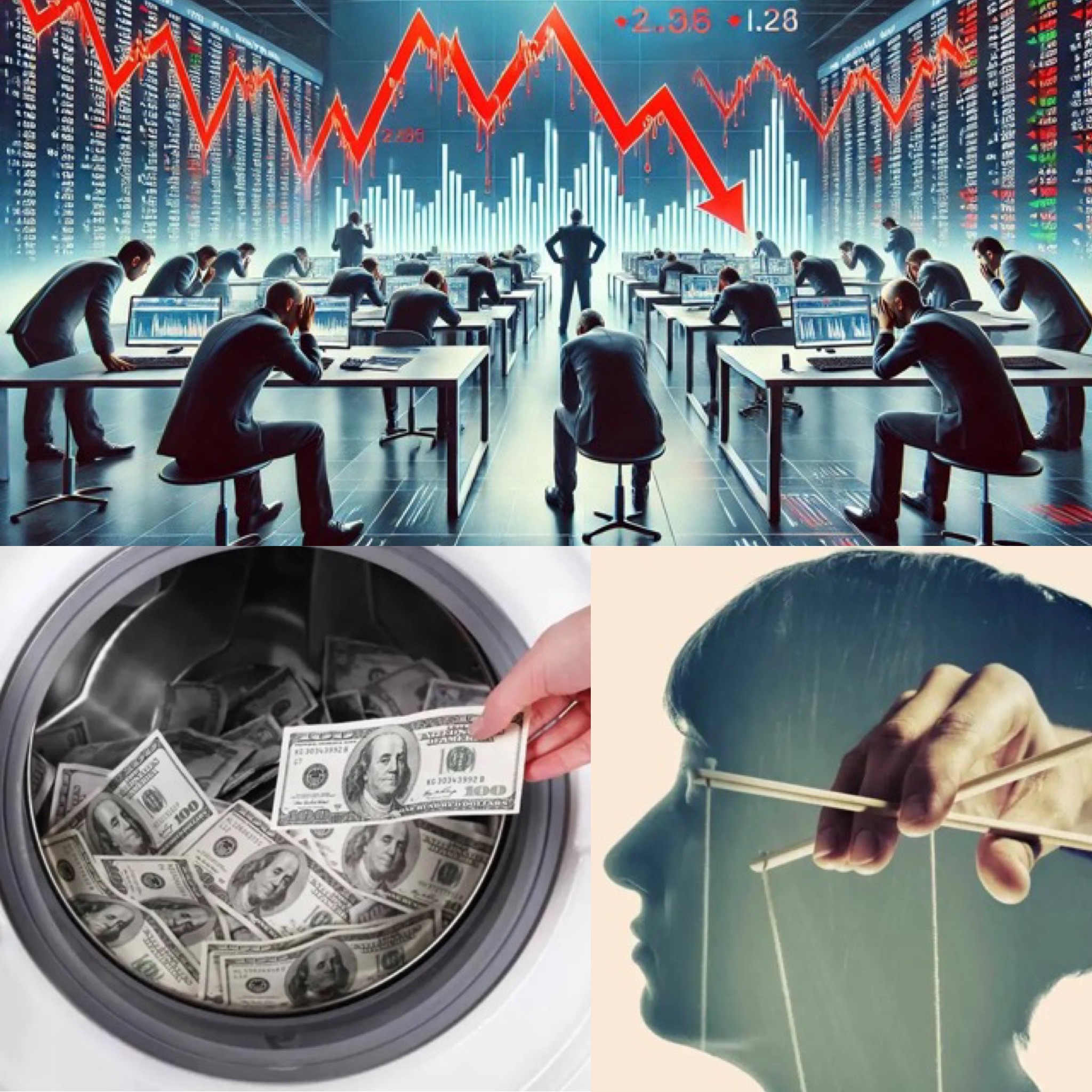
Let me make it clear right from the start—this article is about fraud, manipulation, speculation, and deception within the securities sector. Of course, there are still investors who are trying to make an honest living and build a legitimate source of income in this space. But from what I’ve observed, the number of honest individuals operating in the securities market is decreasing with each passing day. The ones who care about sustainable income usually end up leaving Turkey after a while. That’s because many publicly traded companies are struggling, reflecting the worsening state of the Turkish economy. The number of failing or bankrupt companies is growing, and the devaluation of the Turkish lira wipes out any gains from stock market investments when measured in foreign currencies—in fact, it often results in massive losses.As the dollar and euro continue to rise against the Turkish lira, those losses only deepen. At some point, foreign investors throw in the towel and exit the market, taking their losses and leaving with frustration. If you ask me, if the Central Bank stopped intervening and let the exchange rate float, the dollar could easily soar past 100 TL. Just imagine the destruction that would bring to the markets.
In an environment of such economic crisis, the playing field is left wide open for fraudsters and scammers. These individuals have made manipulation a way of life—not just financially, but also socially and personally. They don’t just deceive local and foreign investors; they also launder money and manipulate people in their private lives. Unfortunately, the field is increasingly being taken over by people like this.
A Bad Sector Has Gotten Even Worse
About 10 to 15 years ago, I dated a woman who was a high-level executive at a prominent securities firm. As I learned more about the sector and the stock market from her, I started to form a very negative impression of the industry. Looking at where we are now, I can say that the situation has only gotten worse—both in terms of employee quality and the financial sustainability of publicly traded companies.
This woman was hardworking, ambitious, and had achieved her position entirely through her own efforts. Some of the things she told me back then have stuck with me to this day:
A Darker Side of Finance: Manipulation, Fraud, and Dirty Money in Turkey’s Securities Market
The overall quality of people working in the sector is extremely low. Even those who appear educated on paper often come across as petty, insecure, and lacking in refinement.
Our job basically boils down to convincing people to invest in the stock market, and when things go wrong, we’re tasked with calming them down and keeping them from causing a stir.
Even the most “technically sound” analyses in Turkey are often empty and superficial. At the end of the day, everything comes down to personal relationships. Most people talking big in this area are just bluffing, and you can only fool people for so long.
The limited number of solid, trustworthy companies in Turkey makes for an extremely shallow investment landscape.
The flow of illegal money into Turkey is increasing day by day. This influx artificially inflates the stock market.
No one really cares about the education level of those in the sector. It all comes down to how well you can convince people.
Starting a securities investment firm is nothing like it appears from the outside. It’s not profitable at all. In fact, many of those who start their own firms and flaunt the “CEO” title are actually laundering money.
After sharing all this with me, she said that dating someone outside the industry, like me, gave her peace of mind, especially since she was constantly surrounded by negativity. That relationship helped her decompress.
After writing about corruption and crime in the fintech world last week, I felt compelled to turn my attention to the part of the financial sector that, in my view, has the worst reputation and the longest rap sheet: the securities market.
Aside from what my former partner shared, I’ve witnessed plenty myself. Back when the Capital Markets Board (CMB) was headquartered in Istanbul’s Süzer Plaza, I was working at my family’s business nearby. I had a front-row seat to the behavior and demeanor of investors and investment firm executives who were summoned for questioning by the CMB.
Low-Quality People, Fake Personas
I saw it all—guys who looked like gangsters, washed-up athletes, people who looked like beggars, others decked out in luxury clothes, rolling up in flashy cars, renting homes and offices in Istanbul’s posh neighborhoods just to impress, entering the CMB all cheerful and leaving pale-faced or even getting arrested right after the investigation. I’d run into these types everywhere: in the lobby, in elevators, in hallways.
What they all had in common was a total lack of quality, artificial behavior, a desperate need to seem more important than they were, visible inferiority complexes—especially toward confident people—and an overwhelming urge to get rich quick.
The 50 Shades of Fraud
Naturally, among people like this, some don’t have a single moral boundary. Many of them build their entire financial foundation on illegal activity—dirty money. And “dirty money” can come in many forms. At its simplest, it involves money made through criminal means (e.g., drug trafficking, smuggling) being funneled into the stock market via investment firms. Or it could be bribes collected by public officials, funneled through offshore channels and “cleaned” via local investment firms.
These firms don’t just handle the laundering—they build their entire infrastructure around this money. They even create funds and give them deceptive names, often imitating the names of foreign firms or successful institutions to appear legitimate. Then, they lure retail investors into these shady funds, giving them the appearance of popularity and legitimacy. In the end, they use these funds and investment channels to launder stolen or illegally obtained money.
Delusions of Grandeur by the Clueless
They go to investor meetings and talk up their “strategies” with theatrical flair, claiming no one can beat their returns. They create fake online personas and brand themselves as investment geniuses. What cracks me up is that even the most clueless ones try to brand themselves online as “Turkey’s Warren Buffett.” But come on—this is Turkey. Standards have dropped so low that even nonsense finds an audience. Warren Buffett and these clueless self-proclaimed gurus aren’t even in the same universe.
When knowledgeable investors ask them real technical questions, they get defensive. They’re bold when the room is full of amateurs, but once someone challenges them, they lose their cool and try to intimidate the other person.
They even participate in international forums to appear more legitimate, claiming foreign investors prefer working with them. To back that image, they’ll pay foreigners to be on their boards—people who may have nothing to do with finance. They know that appearances are everything, so they’ll even pay to use the names of Europeans or foreigners who are financially struggling, just to seem more global.
Image Is Their Lifestyle
Using the perks of dirty money, they rent flashy waterfront offices along the Bosphorus. They bring investors there to impress them and try to convince them to invest in their shady funds. Smart, long-term-focused foreign investors, however, quickly realize what’s going on: the state of the Turkish economy, the currency risk, and the flaky nature of the people trying to pitch them. Even if they invest by mistake, they usually back out soon after.
And it doesn’t stop at the office. These people rent luxury homes on the Bosphorus to appear elite in their personal lives, too. They’re obsessed with manipulating people—especially their investors and social circles—into thinking they’re more powerful or successful than they really are. If you even mention the word “dirty money” around them, they’ll flat-out deny it and act insulted. But the truth is, these people have dark secrets they hide from even those closest to them. They’ll go to great lengths to cover up any traces of their shady dealings.
They use their influence and criminal networks to channel outside money into a market that no sane foreign investor would touch. Then they build their entire image online around this and portray themselves as experts.
But in the end, all wrongdoing eventually comes to light. And if it doesn’t, divine justice has a way of finding these manipulators, speculators, fraudsters, and liars. People who hurt others and destroy lives always pay the price somehow.
Understanding the Game: Manipulation in Turkish Markets
Now that I’ve described the types of people dominating this space, let’s dive into how market manipulation works in Turkey. There’s an excellent article on Para Analiz titled “The Stock Market Game: From Fooling Rookies to Large-Scale Operations – What Are the Common Manipulation Methods?”
[Recommended Reading
Check out this comprehensive article on Para Analiz:
“The Stock Market Game: What Are the Manipulation Methods from ‘Bagholder Traps’ to Major Operations?”
Read here
The article begins by explaining “What is Market Manipulation and How Is It Done?”
Common Methods:
Pump and Dump: Artificially inflate stock prices, then sell off at the peak.
Dump and Pump: Push prices down, buy in cheap, then drive them up.
Fake Orders: Place misleading buy/sell orders and quickly cancel them to influence investor behavior.
These tactics are often executed in milliseconds using algorithmic trading.
Manipulation vs. Speculation:
Manipulation is done with deceitful intent, aiming to steer the market. Speculation, on the other hand, is a high-risk strategy based on market forecasts without spreading misinformation.
Spotlight on Deep Players in Borsa Istanbul:
While manipulation used to be confined to low-volume stocks, recent volatility has reached even high-volume stocks in the BIST 100. Experts warn that powerful entities with political ties may be behind these swings.
Regulators Must Step Up:
Curbing manipulation depends on oversight from the Capital Markets Board (SPK), Borsa Istanbul, and the judiciary. Otherwise, the erosion of trust will threaten the entire capital markets ecosystem.
The profile I described earlier fits the “deep player” described in the article.
For more on the legal consequences, read:
“What is the Crime of Stock Market Manipulation and What Is the Penalty?” by Or Law and Consultancy
Read here
According to Article 107 of the Capital Markets Law, penalties for manipulation include:
2 – 5 years in prison
Judicial fines up to 5,000 days
These penalties can be increased if the crime is organized or involves public officials. Even
* social media comments,
* calls to buy/sell in groups like Telegram or X (Twitter),
* coordinated trades from the same IP, and
* mass transactions without due diligence
can be classified as manipulation.
A conviction will appear on your criminal record, which may prevent:
Employment in public service
Working in banking or finance
Participating in public tenders
Don’t Forget: Money Laundering Is Even Worse
Money laundering carries even harsher penalties. For a deep dive, I recommend reading:
https://www.capa.av.tr/kara-para-aklama-sucu-ve-cezasi/
To put it simply: Criminal organizations need to launder their illicit gains to fund themselves. When they do, their capacity to commit further crimes grows. This is why Turkish Penal Code Article 282 defines laundering as a crime—it gives illegal wealth the appearance of legitimacy and encourages further wrongdoing.
Common Money Laundering Methods:
Loan-back schemes
Shell or fake companies
Offshore tax havens
Structuring (splitting large sums into small transactions)
Smurfing (using many individuals to move money)
Physically moving funds abroad
Casinos
Currency exchanges
Businesses that primarily deal in cash
Alternative remittance systems
Fake invoices or phony exports
Online banking
Falsified billing
Penalties Still Fall Short Despite Everything
I would also like to emphasize the penalties for money laundering. The punishment for this crime varies depending on the specific actions involved. According to Article 282/1 of the Turkish Penal Code, if any of the aforementioned alternative actions are committed, the offender is subject to 3 to 7 years of imprisonment and a judicial fine of up to twenty thousand days. If a person did not directly participate in the crime but knowingly purchased, accepted, possessed, or used assets derived from the crime, they will be sentenced to 2 to 5 years in prison. If the crime is committed by a public official or a person in a professional capacity, the sentence is increased by 50%.
As I’ve stated before, while these penalties may be sufficient to ruin the lives of money launderers, I personally believe they should be much harsher. We live in an environment in Turkey where criminal organizations operate freely, where the line between right and wrong is blurred, and where every imaginable method is used to cover up crimes like money laundering and market manipulation.
I wish for a truly just world—a world where good and evil are clearly distinguished, where divine justice prevails, and where those who do real harm to people’s lives are fully held accountable for their actions.
And I’m not just wishing for it—I promise to do everything in my power, for the rest of my life, to help bring about such a fair environment.
Note: Let me explain why I used the word “hyena” as a metaphor to describe a certain type of person in this article. Hyenas are among the most predatory and opportunistic animals in the wild. Whether alone or in packs, when they see a chance, they seize it without hesitation to bring down their prey. Especially if they find a wounded, exhausted, or abandoned animal (like a gazelle), they never miss the opportunity. They strike quickly, and with their ear-piercing cries, they end the helpless animal’s life.
Some of the individuals I’ve mentioned in this article—those who manipulate the stock market—share the same character traits as hyenas. They ruin the lives of vulnerable people they’ve targeted. As soon as they sense someone is psychologically weakened, they exploit the situation.
And yes, there are also striped hyenas native to Anatolia. Sadly, even our own land breeds these ugly, opportunistic creatures. In the video titled “Anatolian Hyenas” below, you’ll find the following description:
The tips of their white manes are black. In moments of danger, they puff up their manes to make themselves appear larger than they really are. They usually roam and hunt alone and do not migrate. This is the story of the striped hyenas of Anatolia.