
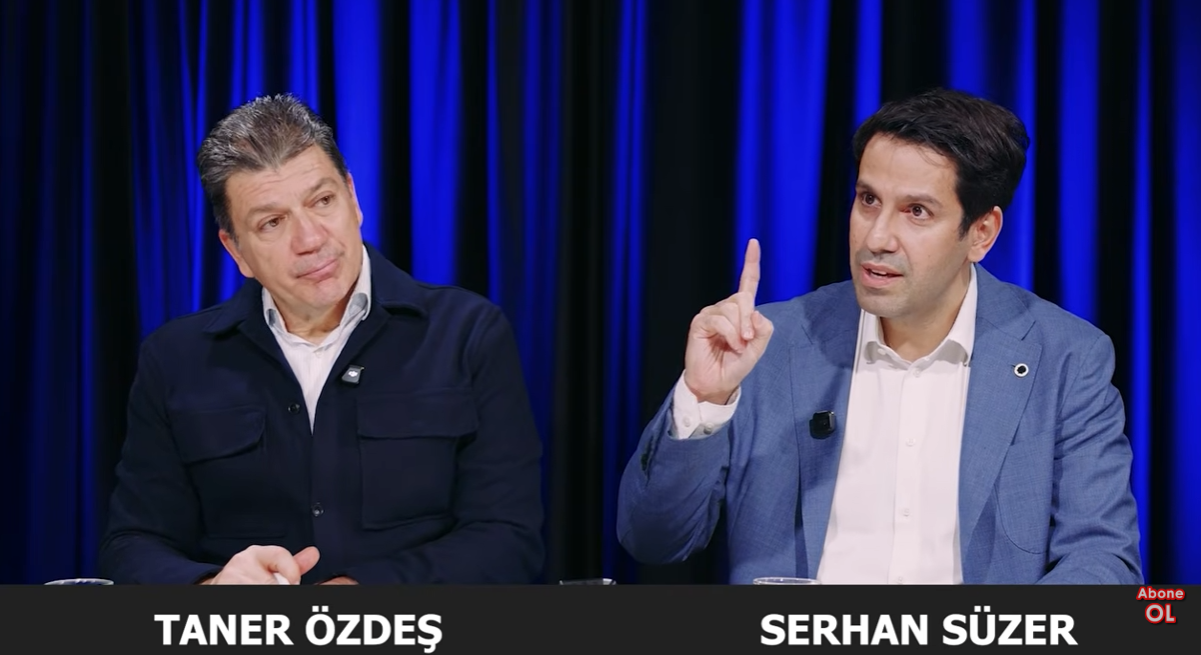
First of all, I would like to thank Taner Özdeş for this wonderful interview. I will share the interview with you and then discuss the lessons learned. If you have time, I recommend watching it:
https://www.youtube.com/watch?v=tIq5lbldc_c
Now, let’s get to the summary of the interview I conducted with the help of ChatGPT. In this first part of the interview, I explain why I turned to entrepreneurship, why I felt it was “necessary” despite my family legacy, and the critical turning points in my career. I say that my main motivation is not money or title, but “the urge to change things.” I particularly emphasize that my early interest in the climate crisis and renewable energy pushed me onto a different path from the usual family businesses. I stress that the most critical element in entrepreneurship is not the idea, but execution; and that courage often comes from self-confidence and the will to solve problems along the way. I also mention that in my approach, even if there is a Plan B, I always insist on Plan A in practice.
Highlights of the Interview
I dedicate a significant part of the interview to my experience in Canada, where I spent my university years. I mention that going to Canada was one of the turning points in my life and share my story of being accepted to the university: I explain that after being initially rejected by the university, I didn’t give up, I went to the school in person to appeal, and I was accepted after the university realized the incorrect TOEFL score. I share this story as an example of persistence and determination in entrepreneurship.
I say that Canada contributed two major things to me:
1) Gaining a “global citizen” perspective in an international environment,
2) Getting acquainted with a strong entrepreneurial ecosystem at an early age.
One of the most striking anecdotes is the part about my friend Jesse in Canada. Jesse dropped out of university and started a web hosting company, and invited me to become a partner. I explain that as a result of an agreement I made with my father, I worked in America for a while and then returned to Türkiye. Later, I learned that Jesse sold his company to AT&T for hundreds of millions of dollars. This story stands as a powerful example in the interview of both “missed opportunities” and the cost of life choices. I tell this story not so much as a regret, but as a turning point showing how my own path was shaped. You can read the full story in my blog post titled “My 15 Years in Business and Notes for the Future,” which I wrote and can be found at https://serhansuzer.com/tr/15-yillik-is-hayatim-ve-gelecege-notlar/ .
Raising the Quality Bar of the Sector
On the family side, I also discuss the three-generation entrepreneurial line in the interview. I mention that my grandfather and father were also entrepreneurs, but that instead of simply inheriting from my father, I charted my own course. I state that I joined the family business during a very difficult period when Kentbank was seized, and therefore I carry the peace of mind of having “put my hand under the stone in the most difficult time.” Here, I explain that the responsibility of reviving the family business during a crisis is one of the main experiences that shaped my management approach.
In the Ritz-Carlton and Süzer Plaza sections, I emphasize that Ritz-Carlton raised the standards of hotel management in Türkiye and increased the quality bar of the sector. Regarding Süzer Plaza, I acknowledge that the building’s aesthetics could be criticized; However, I particularly emphasize that the structure was not built illegally, but rather within the framework of the zoning and judicial processes of the time. In other words, I consider the criticism of public opinion legitimate, but I categorically reject the accusation of “illegality.” You can hear the full story of Süzer Plaza in this interview I conducted with Taner Özdeş.
Vision, Persistence, Execution, and Value Creation
Regarding KFC and Pizza Hut, I offer a more operational assessment. I explain that KFC is a stronger operation, while Pizza Hut, over time, has ceased to be a differentiated brand in Türkiye and has become commonplace. I explain that one reason for this is that pizza doesn’t have as strong a cultural presence in Türkiye as it does in America, and because pizza making is relatively easy, it has become a commodity, making it difficult to compete with local alternatives.
In general, the main message of the interview is this: I see entrepreneurship not so much as “leaving a comfortable life and taking risks,” but rather as a matter of vision, persistence, execution, and value creation. I also frame my own life story within this context; I’m discussing climate change, my experience in Canada, missed opportunities, family crises, and corporate transformation. Now, let’s get to the entrepreneurial lessons to be learned from this interview.
Lessons to be Learned from Entrepreneurship
1) Entrepreneurship often doesn’t begin with “leaving comfort zone and taking risks,” but with taking a problem to heart.
In my interview, the main motivation for entrepreneurship is not money, but “the desire to change things.” My early interest in climate change and renewable energy (which stemmed from my concern about snow quality due to skiing) shows that the strongest fuel for entrepreneurship is personal meaning and sensitivity to problems.
2) Execution is more important than the idea.
This is one of the clearest lessons in the text: A good idea alone is not enough; what truly makes the difference is being able to carry the business forward despite the difficulties after starting. In the interview, I explicitly state that “execution is the most crucial aspect of entrepreneurship.” In the same section, I emphasize the critical importance of choosing the right sector; that is, good execution + the right market is the key to success in entrepreneurship.
3) Courage doesn’t come from knowing everything; it comes from believing you can overcome shortcomings along the way.
My approach here is not “let me be fully prepared first,” but “I’ll start, then solve the problems.” In other words, it’s the “you figure it out along the way” mentality. This highlights the ability to navigate uncertainty as one of the fundamental skills of entrepreneurship. I’m trying to explain that, especially in early-stage ventures, learning through experience is a more realistic model than expecting flawless information.
4) Persistence sometimes trumps talent.
My experience of initially failing to get accepted to a university in Canada, then going there myself to expose the mistake and ultimately getting accepted, teaches a powerful entrepreneurial lesson: It’s not about the first door closing, but about testing whether that door has truly closed. In the interview, I directly link this to the idea of ”don’t give up on something you really want.”
5) An international network isn’t just about networking; it’s about transforming mindsets.
The Canadian experience gives me both a “global citizen” perspective and a closer connection to the entrepreneurial ecosystem. The lesson here is that a good network isn’t just about connections, but a leverage that broadens horizons. For someone who wants to be an entrepreneur, the right environment can often be more transformative than school or their first job.
6) Great opportunities are sometimes missed; the important thing is to turn this into a personal compass.
One of the most striking parts of the interview was learning that Jesse didn’t accept my offer to partner in the venture, and then later sold his company for hundreds of millions of dollars. The lesson here isn’t just about “missing opportunities”; it’s about accepting that life choices have consequences. Knowing which values you use to say no, since you can’t say yes to every opportunity, is part of entrepreneurial maturity.
Also, you never know what might have happened in a completely different life. If I had partnered with Jesse in this successful venture and then settled in Silicon Valley, I might have encountered circles I would never have wanted or approved of, like Epstein’s. Knowing myself, I would have definitely gotten myself into trouble. Because I would have tried to tell stories about what I witnessed, and even more importantly, to prevent it. My fate is uncertain.
Therefore, returning to Türkiye and joining the family business protected me in a way. A true “sliding doors” effect.*
7) Joining a family business doesn’t have to kill the entrepreneurial spirit.
In the interview, I describe our family’s entrepreneurial lineage, from grandfather to father and from father to myself. But the critical point is this: It’s not enough to simply maintain the family structure; it’s important to add your own dimension to it. This shows the difference between “inheriting the legacy” and “creating value that makes a difference.”
8) Crisis periods build character and leadership.
My joining the family business on the day Kentbank was seized, and “fighting the necessary battle during the most difficult period to get the family business back on its feet,” shows that in entrepreneurship, crisis moments are more instructive than comfortable periods. Taking responsibility in difficult times strengthens our leadership side.
9) Not every business performs equally well in every market; product-market fit is critical.
The comparison between KFC and Pizza Hut illustrates that cultural fit is as important as operational strength. Pizza Hut’s becoming commonplace in Türkiye over time, and pizza’s struggle to compete culturally with local alternatives, reminds us that in entrepreneurship, a “good brand” and a “suitable market” are not the same thing.
10) Even the stories you have to defend can be a lesson in branding and leadership.
In the sections about the Ritz-Carlton and Süzer Plaza, I try to explain the criticized legacies in more detail from my own perspective. I accept aesthetic criticism, but I emphasize legal legitimacy. This also provides an important lesson for entrepreneurs: every success story is also a test of perception, reputation, and narrative management.
I hope what I want to share in this interview will be useful to our fellow entrepreneurs or aspiring entrepreneurs. See you in the second part of the interview.
Note: The movie Sliding Doors deeply affected me. In a sense, this 1998 Peter Howitt film, starring Gwyneth Paltrow, tells the story of a woman whose life is split in two when she misses the subway she needs to take home at the last second. In one scenario, she catches the subway, arrives home early, and finds her husband with someone else. In another, she catches the next train, gets stuck in traffic taking a taxi, and doesn’t know her husband is cheating. Isn’t this how our lives often unfold? (You can watch the trailer here: https://www.youtube.com/watch?v=Da-Mizk86AE)