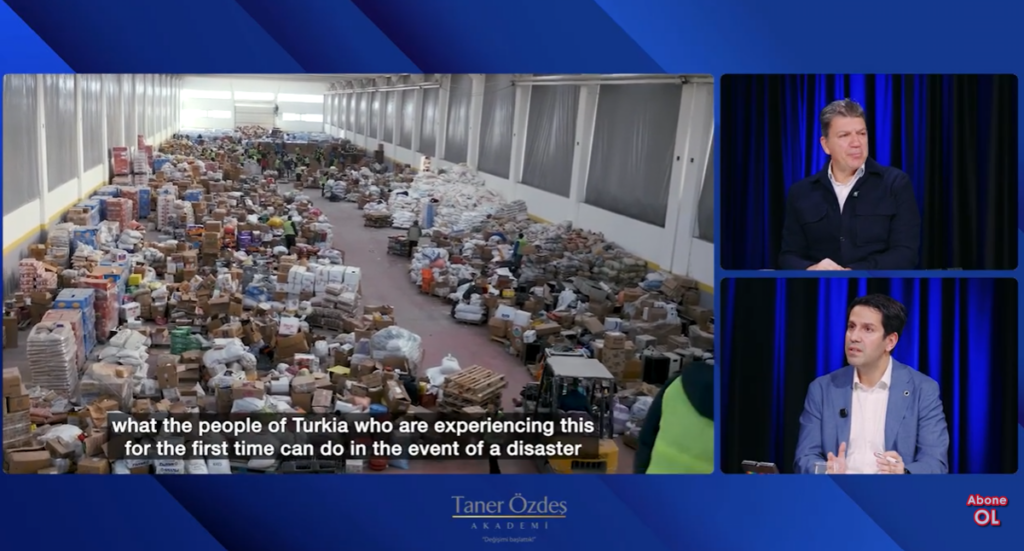
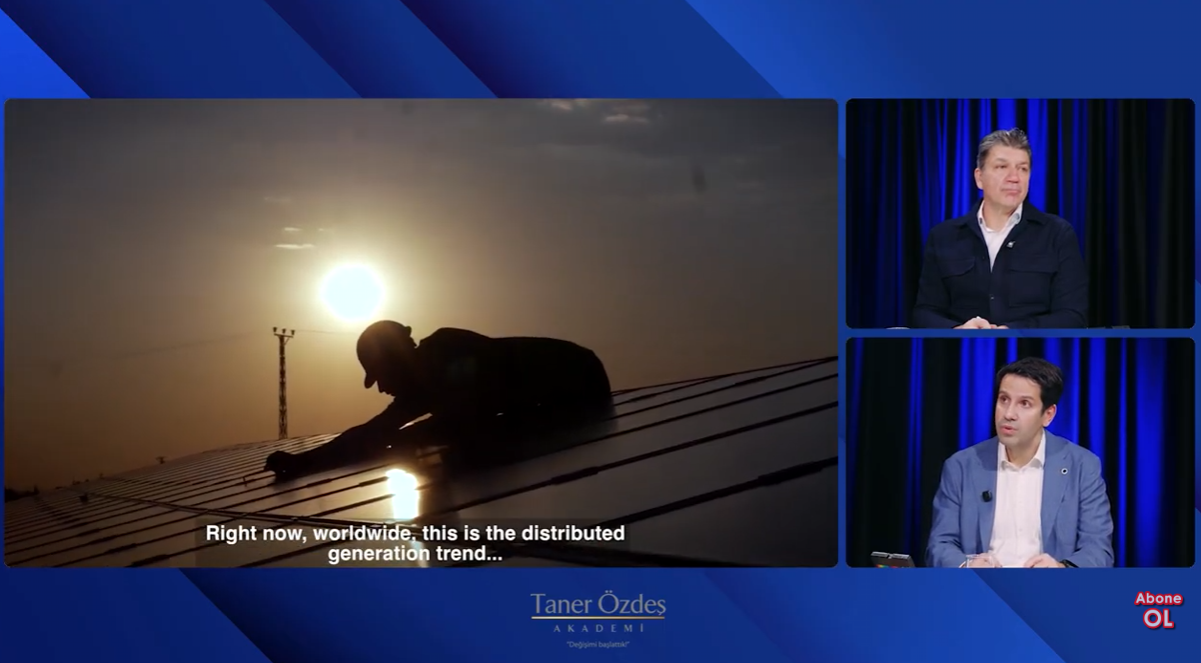
First, let me share the second part of the published interview with you, then I will summarize it and explain the lessons to be learned. If you have time, I recommend watching the second part of the interview:
https://www.youtube.com/watch?v=1i-1WUs-bQ4
Now, let’s get to the summary of the interview I conducted with the help of ChatGPT. In this second part of the interview, I talk about my experiences in renewable energy (especially solar) and fintech (Moka) with examples from my entrepreneurial journey. My early awareness of the climate crisis and my motivation to “produce tangible solutions” influenced my choice of energy. On the fintech side, I emphasize that the payment business requires high compliance and know-your-customer (KYC) discipline; that doing “clean business” may slow down growth in the short term, but increases value in the long term. Regarding partnerships, I say “like a marriage,” explaining that choosing the right partner is critical, and that the wrong partnership consumes energy as well as the company.
Main points of the interview:
1) My perspective on renewable energy: “Technically possible, it requires willpower”
- I explain that I started my career with solar energy and that the sun is the source of everything, stating that my preference has always been for solar energy. I explain the perspective that “the sun is the source of everything” by saying that even wind is fundamentally formed by heat differences originating from the sun.
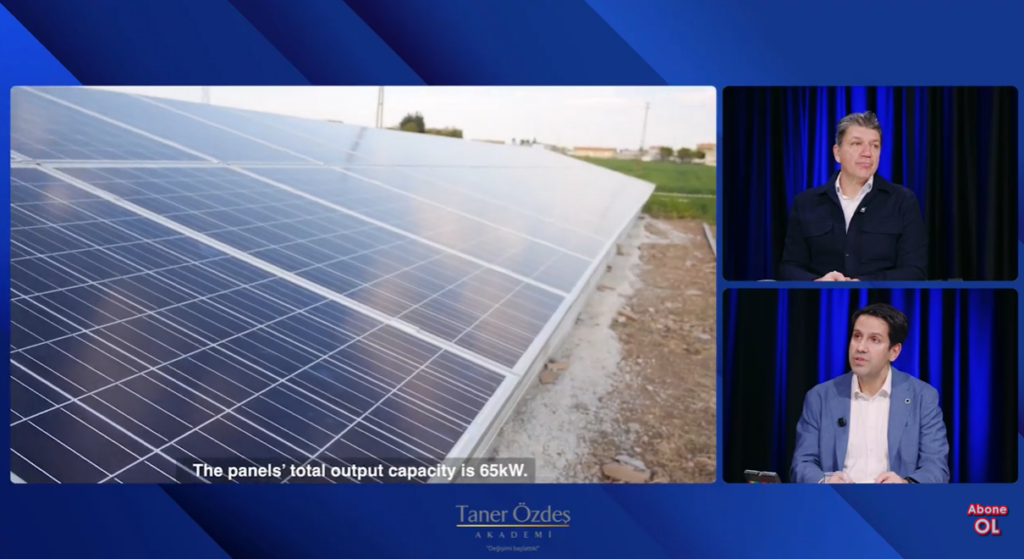
- I emphasize that there are two different types of solar radiation (GHI – Global Horizontal Irradiance, which produces electricity, and DNI – Direct Normal Irradiance, which produces heat), and therefore two technologies that produce this energy: PV (Photovoltaic) systems produce electricity and CSP (Concentrating Solar Power) systems produce heat. I explain that the heat side (meeting the heating needs of industry) is not sufficiently understood.
- I explain that I see Türkiye’s solar/wind potential as “very high,” and that we are still in the early stages in terms of installed capacity.
- I argue that the biggest obstacle is not technology but government will; I reiterate my claim that “100% renewable energy is possible in 3-5 years” and say that long-term targets (such as the 2050s) are much later than they should be.
2) How to start an entrepreneurial venture in the energy business?
- I describe two different roles:
– Those with knowledge can work on the installation/contracting side (know-how).
– Those with capital can directly invest in solar/wind power plants.
- I emphasize that the “sales and marketing” burden in the energy business is not like that of the hotel industry; the real challenge lies in obtaining permits and adhering to the correct installation standards (I underline the risks of fire, etc., if standards are not followed).
- I explain how I experienced problems in my wind energy project due to the turbine company’s bankruptcy and a serious accident in logistics, such as a blade falling, but how I recovered and achieved a successful “exit.” Of course, perseverance and proper crisis management enabled us to overcome these challenges.
3) Fintech (Moka) and the “clean business” lesson
- I mention that I founded Moka in 2014 and sold it to İş Bankası in 2021; I describe our virtual POS/web POS services in e-commerce as a payment processing company.
- I emphasize that the most critical risk in the payment business is money laundering/unsuitable customers; and that it requires even more rigorous customer monitoring and filtering than banks.
- I explain that when I saw suspicion of “illegal/problematic accounts” in my own company, I drastically restructured the system and strengthened filtering; that this reduced the company’s volume in the short term, but that the offer increased in the İş Bankası audit due to this “clean-up.”
- The takeaway: Reputation, clean operations, and compliance increase company value in the long run.
4) Partnerships: “You deal with partners as much as you deal with the company.”
- I describe partnerships using the analogy of “marriage”; I say, “A good partner accelerates the process, a bad partner becomes a burden.”
- I mention that during the Moka sale process, the partners complicated the process with unethical demands like “Give us this much or we won’t let you sell,” and that I reluctantly had to accept them to avoid a scandal.
- Using the call center merger example, I convey the message, “The synergy was right, but the choice of people turned out to be problematic”: I say, “Vision, reliability, and the way of doing business are decisive.”
5) My clear recommendations for entrepreneurs:
- Cash management: In Türkiye, one of the main reasons for startup failures is poor cash management.
- Right sector + flexibility: I emphasize the importance of pivoting/flexibility (agility) by saying, “I entered the right sector but the wrong technology; then I corrected it.”
- Not becoming overly attached to the product (or technology): In exit decisions, I prioritize the criterion of “Can the buyer company grow the business?” before money. Ultimately, you form an emotional bond with all startups, and after a while, you start to see them as your children. When you sell the company, I state that I want to entrust the responsibility of your child to a place where it can grow and develop.
Lessons to be learned for entrepreneurs
After sharing the summary of the interview with you, let’s break down the lessons to be learned for entrepreneurs point by point:
1) Cash management is vital: A significant portion of startup failures in Türkiye are due to poor cash management.
2) The right sector + the wrong technology; quick correction (pivot/flexibility): As I did in the energy and fintech sectors, choosing the right sector is paramount. If you enter the right sector with the wrong technology, you need to abandon insisting on the wrong technology and demonstrate the flexibility to change it as quickly as possible.
3) In the energy business, “permits + know-how” are more decisive than sales: In energy production, you can sell electricity at market price/agreed price after installation. The real challenge in our energy sector is project development.
4) Standards/quality cannot be neglected: In the energy sector, if installation is not done properly, risks such as fire can arise; it is absolutely necessary not to compromise on high standards. Compromising on standards in order to install cheaply can cost you dearly, both financially and morally, later on.
5) In fintech, compliance/KYC is as critical as growth: I emphasize that customer identification and screening in the payments business must be done “more rigorously than banks.” Just like in the energy sector, if you do your job meticulously and without compromise, growth will follow.
6) “Knowledge or capital?” Both create value in different ways: Anyone can be an entrepreneur. Those with knowledge can do installation/contracting, and those with capital can invest in solar/renewable energy sources.
7) Partnership is like marriage: With a bad partner, you struggle with both the company and the partner; a good partner, on the contrary, accelerates and creates a leverage effect.
8) When choosing a partner, “business practices, vision, and reliability” should be tested: The decision to merge in the call center was correct, but I made the wrong partner choice. I paid the price for this mistake later. I experienced a similar problem in my fintech company. You should also choose your partners carefully.
9) In an exit, it’s not just about money, but also the question of “Can the buyer grow the business?”: The buyer’s capacity and reputation to continue the business are sometimes more important than money. It’s not all about money. Today, I am proud of Moka’s successes.
The interview’s one-sentence message
Let’s conclude my writing with the interview’s one-sentence message for our entrepreneurial brothers and sisters:
Choose the right sector with promising future prospects, get your technology up and running, manage your finances correctly, don’t compromise on standards/compliance discipline; find a partner you get along well with and who can truly contribute to your business, and whatever you do, choose a business that ensures financial sustainability and also benefits humanity.