
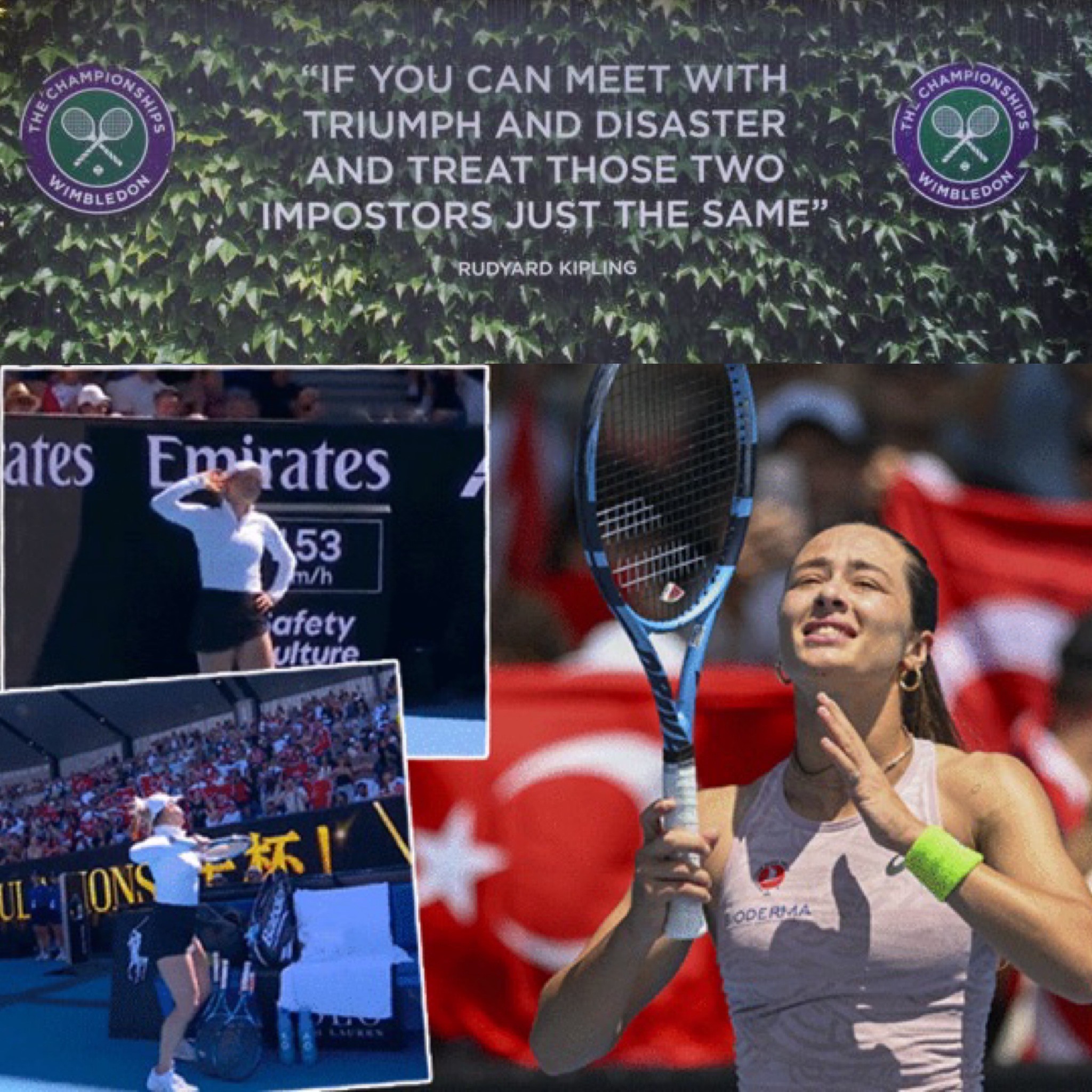
Let’s begin by introducing our protagonist, Zeynep Sönmez (see: https://tr.wikipedia.org/wiki/Zeynep_S%C3%B6nmez ). Zeynep Sönmez (born 30 April 2002, Istanbul) is a Turkish professional tennis player.
Sönmez reached a career-high ranking of 69th in the Women’s Tennis Association (WTA) singles rankings on 20 October 2025. She has won one singles title on the WTA Tour and four on the ITF Women’s Tour.
Now, let’s understand what happened at the Australian Open: Sönmez, who started the 2026 Australian Open, the first Grand Slam tournament of the year, in the qualifiers, advanced to the main draw after passing three qualifying rounds. In the first round of the main draw, she defeated World Number 11, Russian Yekaterina Aleksandrova, 2-1 to advance to the second round. In the second round, she defeated Hungarian Anna Bondar 2-0 to advance to the third round, becoming the first Turkish tennis player to achieve this feat. However, in the third round, she was eliminated after losing 2-1 to Yulia Putintseva, ranked 94th, who is of Russian origin but competes for Kazakhstan.
In the women’s singles third-round match at the Melbourne tournament, world number 112 Zeynep faced Putintseva, ranked 94th, at the KIA Arena (see: https://www.aa.com.tr/tr/dunyadan-spor/milli-tenisci-zeynep-sonmez-avustralya-acika-3-turda-veda-etti/3808424 )
Balance in Sets
Zeynep, the first Turkish tennis player to reach the third round of the Australian Open, did not start the match well. In the second game of the first set, the Turkish national player lost her serve, and after making too many unforced errors in the first three games, she fell behind 3-0. Zeynep then won and broke serve in the next two games, but again failed to be effective on her serve in the 5th game. For the rest of the set, neither player made any mistakes on their serves, and Putintseva won the first set 6-3, taking a 1-0 lead in the match.
Putintseva also started the second set well. Breaking serve in the first game and holding her own serve, Putintseva took a 2-0 lead. Zeynep broke her opponent’s serve in the 6th game to level the set (3-3), and then held her own serve to take a 4-3 lead. Despite leading 40-0 on her own serve in the 11th game, the Turkish player made too many unforced errors and lost her serve. Resisting her opponent’s serve, Zeynep broke serve again in the 12th game to tie the set at 6-6, taking it to a tie-break. Zeynep Sönmez defeated her opponent in the deciding game, winning the set 7-6 and leveling the match at 1-1.
Zeynep Sönmez’s courteous comment
Putintseva also started the final set well, establishing a 3-0 lead after the first three games. Putintseva, making fewer errors, won the set 6-3 and the match 2-1, advancing to the fourth round. You can watch the match highlights in this video: https://www.youtube.com/watch?v=tNzyp1GtBkE
You can also understand how level-headed and well-mannered Zeynep Sönmez is from this post-match interview: https://www.instagram.com/reel/DT931bHjO3J/?igsh=aXlmajh4enE3dGcy
Putintseva’s actions that drew boos from the crowd
Putintseva’s actions after winning her 3rd-round match caused a stir. Following the highly contested match, Putintseva’s “I can’t hear you” gesture towards the stands, her dancing, and her shouting while pointing at the crowd led to boos and overshadowed the on-court action, creating controversy. To help you visualize it, I’m sharing the video showing these ugly actions and the post-match interview: https://www.youtube.com/watch?v=xmZXzsSq8IM
Now let’s get to know Yulia, the anti-hero of the events (see: https://en.wikipedia.org/wiki/Yulia_Putintseva ):
Highest ranking: World No. 20
Yulia Antonovna Putintseva (born 7 January 1995) is a Russian-born Kazakhstani professional tennis player. She reached her career-high singles ranking of World No. 20 on January 27, 2025, and her career-high doubles ranking of World No. 76 on 17 March 2025. She began her career in 2009 representing Russia and has been representing Kazakhstan since 2012. She resides in Moscow and Florida, meaning she lives both in Russia and the USA, but competes in tournaments representing Kazakhstan.
Putintseva has won three singles titles on the WTA Tour and reached the quarterfinals three times in major tournaments (twice at the French Open and once at the US Open).
Putintseva’s history of controversial behavior
Yulia Putintseva is known for her controversial behavior throughout her career, not only due to the recent incident at the Australian Open, but also for other events she has previously caused. Let’s take a look at some of the incidents she has caused (the first ones I’ve identified):
1) In 2013, after a match against American professional tennis player Coco Vandeweghe, she said:
“I have never played a person with the worst sportsmanship… Putintseva… How can anyone comment on my game style after you have already won the match in such a negative way is unbelievable!… Her exact words were “You are a terrible player only serve. I win all the rallies” that comment is totally uncalled for… and on top of it your father clapping while you say this haha, unreal! #venting”
2) In 2024, during her 2-0 set loss to Jasmine Paolini at the US Open, she drew widespread criticism for her actions towards a ball girl. The Kazakh tennis player, who caused the ball to fall to the ground by refusing to take it, was harshly criticized on social media and in the sports community, and was forced to apologize after the incident.
3) In the 2025 season, during her match against Greek tennis player Maria Sakkari at the Bad Homburg Open in Germany, tension arose between the two players during the handshake, and Putintseva’s behavior caused a wide stir in the sports community.
I would like to emphasize that Putintseva, who is one of the bad characters in tennis with her behavior and actions in international tournaments, is actually an exception in such a wonderful sport as tennis. Intense criticism of Yulia Putintseva also comes from her own country, Kazakhstan: “She continues to anger us Kazakhs,” they say. Let’s also share the explanations on this topic: https://www.instagram.com/reel/DT2RO8HDMrk/?igsh=cWluYzB6b2t5Ynk2
It’s time to share with you the rules that everyone who loves tennis knows and tries to apply, rules that produce exemplary athletes who can be role models for the whole society, countries, and humanity. And of course, I would like to sincerely congratulate Zeynep Sönmez, who adheres to all these rules I will list below and is a true role model with her calm and upright character. Those who don’t know Zeynep can watch this video: https://www.instagram.com/reel/DUFsphIAD_h/?igsh=cjk0ZzluaGtvMjlw
A Look at the Unwritten Rules of Tennis
I’d like to share the article I based this section of my writing on: https://www.beaumontetiquette.com/post/tennis-etiquette-the-unwritten-rules-of-the-court
Let’s go over the rules with my own thoughts and additions.
Tennis is not just a game of skill and athleticism; it’s also a sport based on tradition and respect. Whether you’re an experienced player or a beginner, understanding and applying proper tennis etiquette is crucial. This ensures an enjoyable experience for everyone on the court, as well as preserving the integrity and spirit of the game. Here’s a guide to the essential aspects of tennis etiquette that every player and spectator should know:
1) Not Being Late
Not being late is a fundamental but important aspect of tennis etiquette. Be on the court a few minutes before your match time, warm up, and be ready to start on time. Taking your place on the court on time is a sign of respect to your opponent and those who have come to watch you. Those who have dedicated themselves to the sport of tennis know this well.
2) Appropriate Attire
When it comes to tennis etiquette, appropriate attire is essential and varies depending on the court or club. Tennis, especially at tournaments, also has its own tradition of appropriate dress. First and foremost, make sure you wear appropriate tennis attire, including non-marking shoes. Some venues may have specific dress codes, such as requiring all-white attire, so it’s always a good idea to check the rules beforehand. Some prestigious clubs, like Wimbledon, require all-white attire, emphasizing tradition and uniformity. Others may have more relaxed dress codes but still maintain standards such as collared shirts and non-marking tennis shoes. Sometimes, not wearing revealing clothing is also part of the rules. If you are unsure about the dress code, it is courteous to call ahead to inquire and ensure compliance. Respecting these rules shows appreciation for the club’s culture and other players, and makes the game more enjoyable for everyone. Remember, good behavior on and off the court reflects your respect for the sport and its traditions.
3) Warm-up Protocol
During the warm-up, remember that this is not a practice session, but a chance for both players to prepare for the match. Return the ball to your opponent so they can practice their shots. Keep the warm-up time reasonable, usually around five to ten minutes. If it’s a tournament, the warm-up time is usually set. If not, and you’re playing casually, you can extend or shorten the warm-up time according to your opponent’s wishes.
4) Silence and Respect During Points
Maintain silence while a point is in progress. This rule applies to both players and spectators. Avoid talking, cheering, or moving around, as these distractions can disrupt players’ concentration. Once the point is over, applaud good shots and excellent rallies from both sides. Unfortunately, in modern tennis, some players make strange noises while hitting the ball, claiming it’s part of the game. Some players overdo the noise-making to release emotions during a shot. In my opinion, this is not the right behavior.
5) Line Decisions and Integrity
In tennis, players are responsible for identifying the lines on their side of the court. Make your decisions quickly and loudly, using clear language such as “out” or “fault.” Integrity is key to maintaining the integrity of the game. In modern tennis tournaments, we see computer systems used in addition to the opinions and decisions of line judges. These systems graphically identify all lines from every angle of the court and show whether the ball is in (sometimes on the line, or even partly in and partly out) or out. These systems are used in some tournaments when a dispute arises, and in others for any ball that isn’t obvious.
6) Resolving Disputes
Disputes can arise, especially regarding near-line decisions. Resolve disputes calmly and respectfully. If necessary, replay the point to resolve the issue. In official matches, you can object to a referee or line judge if one is present. However, this objection should be done respectfully and not prolong. Respect for the opponent, the referee, and the spectators is essential here as well.
7) Ball Handling
Follow the tennis balls and ensure they are ready for play. When hitting the ball to your opponent, aim for their racket or a point they can easily reach. Avoid hitting the ball over the net aggressively or carelessly. Of course, this applies to practice. If you are playing a formal or informal match, you can hit the ball wherever you want. However, if you are playing an informal match and there is no one to collect the balls, out of respect for your opponent, ensure that you and your opponent collect the balls with equal effort.
8) Post-Match Etiquette
At the end of the match, as a sign of sportsmanship, approach your opponent at the net and shake hands or clink rackets. Regardless of the outcome, it is customary to appreciate your opponent’s effort. Thank the spectators and officials present. Maintain this same attitude whether you win or lose the match.
9) Respect for the Court and Equipment
Treat the tennis court and equipment with respect. Avoid dragging your feet in a way that could damage the surface, and refrain from frustratedly hitting your racket on the floor or net. Avoid aggressive behavior before, during, and after the match. This type of aggression is never welcome in tennis. Always strive to maintain your dignity and composure. Collect all balls and dispose of any litter before leaving the court.
10) Spectator Behavior
Spectators also have a role in upholding tennis etiquette. Watch the match quietly and avoid distracting the players. Applaud good play and show respect to all participants. Avoid coaching or giving advice from the sidelines. Of course, one of the most debated issues in the Zeynep Sönmez and Yulia Putintseva match was the behavior of the Turkish spectators. Putintseva defended her actions after the match, saying they were a reaction to the spectators’ behavior. She mentioned that some people coughed while serving and made unnecessary noises during the match. If this happened, she was justified in being angry. Turkish tennis spectators should have watched the match more calmly. Let’s be self-critical about this.
However, let’s not be too unfair to ourselves. We have a culture of mercilessly criticizing ourselves. We exaggerate everything. Looking at other matches, there were spectators who cheered even louder than us. Tennis professionals say Turks are passionate and fair. We witnessed Putintseva complaining even for seeing the Turkish flag in her field of vision, and engaging in all sorts of provocations during and after the match.
Watching the match, we witnessed the spectators receiving two warnings. The referee saw no problem in allowing the match to continue. Putintseva’s reactions here were inappropriate. She could have empathized with the spectators’ passionate reaction to witnessing a Turkish tennis player in the third round for the first time, and reacted to the situation with a calmer attitude. I’d like to share a comment I agree with on this matter: https://www.instagram.com/reel/DT8eR-VDd-f/?igsh=emk1Z281MHZyMXpo
Types of Tennis Courts
When playing tennis, it’s important to remember that there are many types of courts you can play on, both indoors and outdoors. Tennis is a game played on a variety of surfaces, each offering a unique playing experience. Grass courts, like those at Wimbledon, are fast and slippery, allowing the ball to slide and creating a faster game tempo. Clay courts, common in Europe and Latin America, are slower and offer a higher bounce, supporting baseline players and long rallies. Hard courts, the most common surface, are made of asphalt or concrete and provide consistent bounce suitable for all playing styles. There are also indoor courts made of carpet, rubber, or acrylic, which provide a controlled environment regardless of weather conditions. Personally, I think we will witness different types of courts made from various materials in the future.
Tennis etiquette isn’t just about following the rules; it’s about respecting your opponent, the umpires, the spectators, and the game itself. By practicing good etiquette, you contribute to a positive and enjoyable atmosphere on and off the court. Whether you’re a player or a fan, these unwritten rules help preserve the beauty, dignity, and integrity of the sport of tennis.
The Kipling line synonymous with Wimbledon
Let’s look at what happened to Yulia Putintseva, who displayed all this disrespect, in the next round. She suffered a crushing defeat, losing 6-0 6-1 to the promising 18-year-old Serbian-American tennis player Eva Jovic. Disrespect tennis, and karma will eventually get its “what comes around, goes around:” https://www.instagram.com/reel/DT60l9tE8d1/?igsh=MWVuMDg4NXRldTYxbw==
I’d like to conclude my writing with a famous quote from Rudyard Kipling’s poem “If…” which is synonymous with Wimbledon and reflects the spirit of tennis:
“If you can meet with triumph and disaster and treat those two impostors just the same…”
As Djokovic emphasizes, the key to success may not be constantly trying to think positively, but rather avoiding spending too much time on negative thoughts. It’s about cutting off negative thinking, focusing on the present moment, and looking ahead. Those who can maintain and strengthen their mental fortitude in this way become elite athletes, architects, engineers, chefs, businesspeople, and so on.
Bonus: This tactic of Djokovic’s for maintaining mental strength can be adapted to all sports and even to everything in life. I’ll also share the views of an elite athlete who has broken records in freediving: https://www.instagram.com/reel/DSR7bg1jChQ/?igsh=MW45ZDEwYzM5ODdpYQ==
Note: I have written many articles about tennis in the past, including this one. Tennis is personally one of my favorite sports. For readers wondering how my interest in tennis began, I recommend reading my blog post where I recount how my tennis career ended before it even began: https://serhansuzer.com/tr/universite-gunlerime-dondugum-bir-hafta-sonu-ve-baslamadan-biten-tenis-kariyerim/