
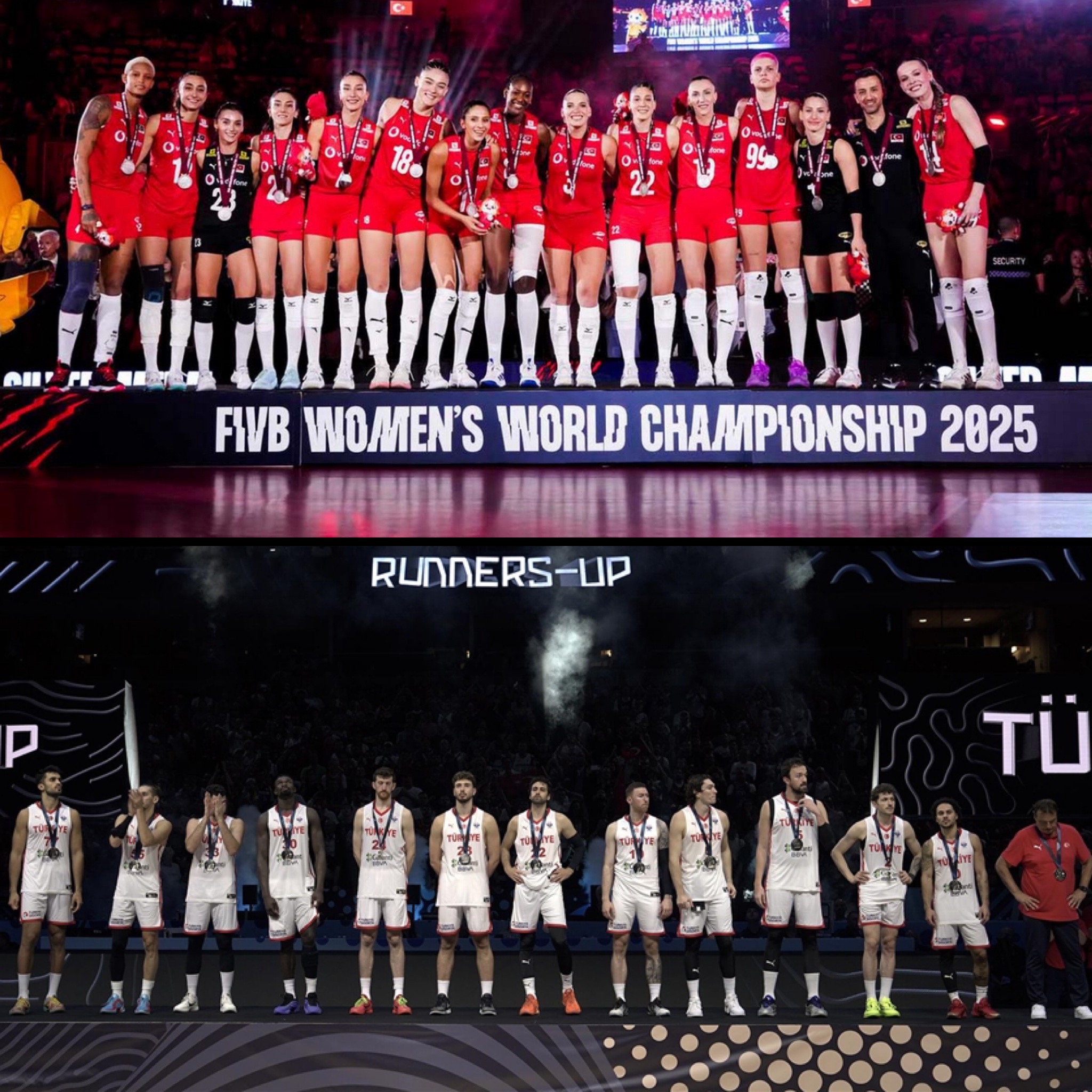
I believe there are three main reasons why we haven’t been able to win a championship, even with the national teams we consider our most successful generation:
1) Technical errors
2) The lack of proper planning to achieve long-term goals
3) The lack of international sympathy for our country
Let’s get started. I’ll continue by giving examples of our women’s volleyball players, who ranked second in the world, and our men’s basketball players, who ranked second in Europe:
1) Technical Errors That Were Committed
Although our players and coaching staff (the coach and his team) are top-tier, they are also human and can make mistakes or be off-duty at times. I recommend listening to the technical analysis of the game at this link: https://www.youtube.com/watch?v=qjtda0zsPFc
In short, we lost the game in a tie-break. This was largely due to Melisa Vargas, who scored over 30 points throughout the game, scoring only two points in the tie-break. One reason for this was that Italy, with a defensive strategy, fielded almost three liberos in the tie-break. Furthermore, Italy has two excellent top-tier opposite hitters: Egonu and Antropova. However, Italy’s best players have always had good alternatives. Our biggest disadvantage, however, is that we have a group of players we can double-substitute. Our best players, like Vargas, Eda, and Ebrar, are among the tournament’s best, but the rest of the team doesn’t have the potential to fill the gap after our best players leave the game. This problem particularly affected the team when we needed to make two-way substitutions or play two-way liberos. Furthermore, when we focused too much on Vargas and Ebrar in attack, poor performance by either player significantly increased our chances of losing the game. Indeed, in the final game, Ebrar played poorly, and the entire burden fell on Vargas.
Italy, by contrast, is a complete team. They’re all hands-on deck. The team’s levels are similar.
Another shortcoming was the lack of physical spikers. Antropova, who is over 2 meters tall, dominated the blocking, especially in the tie-break, and we couldn’t overcome her blocking, resulting in our loss of the final set.
We face a similar situation when it comes to our basketball team. The team’s coach generally kept the same starting lineup and made two or a maximum of three substitutions. Throughout the tournament, we observed two players who generally dominated the game, driving the team, and receiving the most playing time: Alperen Şengün and Cedi Osman. Just like Vargas and Ebrar in volleyball, these two players became the team’s pillars. Cedi Osman was injured for a while but continued to contribute. Ercan Osmani, Furkan Korkman, and Shane Larkin, who occasionally stood out in various games, also made significant contributions to these two players. The rest of the team didn’t play badly either, but it wasn’t a case of “all 12 big guys played very well, they were all the same” situation. For example, we barely saw Ömer Faruk Yurtseven on the court, who could have made a significant contribution with his size and excellent technique.
In the final game, we couldn’t stop German guard Dennis Schröder. Schröder, a black basketball player born and raised in Germany, culminated his excellent performance throughout the tournament in the final game. The fact that our Shane Larkin, who could play toe-to-toe with him, wasn’t on his game, and that our other guards, Şehmus Hazer and Onuralp Bitim, weren’t playing at that level, showed us that a good guard can almost single-handedly dominate and win a game. We also failed to defend Schröder.
2) Planning is still not done properly to achieve long-term goals
We can’t seem to master long-term planning. We need to provide our national teams with players who can play at the highest level or reach that potential. There are two ways to achieve this:
I) Developing players from the youth academy: This isn’t just about the youth academy of Vakıfbank, Eczacıbaşı, or Fenerbahçe in volleyball, or Anadolu Efes and Fenerbahçe in basketball. All teams in the First League need to have very well-organized youth academy structures. Developing players from scratch isn’t easy, admittedly. You can’t predict who will achieve which position. However, with the right system, our success rate can be significantly increased. Currently, the star of the national basketball team, Alperen Şengün, Şehmuz Hazer at second guard, and Ercan Osmani, the star of the game against Greece, whom we eliminated in the semifinals, are all players from Banvit (Bandırma). Unfortunately, Banvit was shut down after being sold to foreign investors. Imagine, a basketball team that closes contributes to three key players who are practically the backbone of the national team. We also extend our respects to Banvit’s former owner, visionary and basketball enthusiast Ömer Görener. Mr. Görener spent a great deal of money supporting Turkish basketball, but in return, he achieved great things. Banvit’s absence will be felt. I repeat: All teams in the First Basketball League must follow Banvit’s example and invest in their youth infrastructure. Otherwise, we will have no long-term future in basketball. The same applies to all sports.
II) Transferring the best players from abroad: Whether it’s transferring young players from youth academy or more mature players, the more we bring in good, high-potential players from abroad to our leagues, the higher the bar we raise in sports. Because the players who train with them also develop. The transfer of Melissa Vargas in volleyball and her subsequent recruitment to the Turkish National Team is a prime example of this. However, we haven’t been able to fully maintain this strategy since Melissa’s death.
Ekaterina Antropova is one of the two most important players behind Italy’s rise to great success and championships over the last two years. Did you know that Antropova, who stands over 2 meters tall and dominates the net, is an Iceland-born Russian? Did you know that she was brought in by Italy in 2023? Since her arrival in Italy, Italy has been leading and winning every tournament. Neighboring Türkiye could have signed Antropova, a Russian, just like Vargas. Then, we would have been the clear favorites.
Paola Egonu, another of Italy’s best players, is also the child of Nigerian immigrant parents.
Dennis Schröder, Germany’s best player, whom we lost to in the basketball finals, was also the child of Gambian immigrant parents.
I have given you an example of two of Europe’s most nationalistic countries. Germany and Italy, which used to have no foreign players on any of their national teams, have always had the best players in both basketball and volleyball who are immigrants or the children of immigrants. We are witnessing a similar process in football and other sports. This demonstrates that racism is an obstacle to success and that long-term planning must include both Turkish and foreign players, both in the youth academy and beyond. In other words, the doors must be wide open for recruits.
As things stand today, our national teams, without our best guard Shane Larkin in basketball and our best player Melissa Vargas in volleyball, cannot even advance past the quarterfinals of the tournaments they participate in.
3) Lack of international sympathy for our country
Some may say this isn’t a big deal. Whether they sympathize or not, they might make comments like, “If we play well, no one can beat us.” However, especially in sports competitions, sometimes you can’t be in your element. In such situations, small nuances can win or lose a game, depending on whether the opposing team plays well or poorly. For example, in basketball, we narrowly won the game against Serbia. Any other mistake could have caused us to lose the game, and our fate in the tournament would have been altered.
Unfortunately, politics can also enter sports competitions. Sometimes, referees officiating a game can be influenced by political events and subconsciously use their discretion in favor of the opposing team. If the power differential is large, the referee’s discretionary power may not be as significant. However, if the two teams competing are evenly gamed, the referees’ attitude directly influences the winner.
Discretionary power can be decisive.
In my opinion, the Germany game in the European basketball final was such a game. We frequently witnessed referees’ decisions targeting Germany during games. If we had been a country with political and image sympathy, and one or two of those decisions had been in our favor, perhaps we would have won the game. Of course, I’m not referring to Schröder’s intervention late in the game and his single-handed victory. The decisions made throughout the game prevented us from pulling away. We could have won this game despite Schröder. Although our team fell apart a bit in the final quarter and couldn’t show the necessary defensive resistance, let’s not overlook the importance of exercising discretion and sympathy.
I hope that Türkiye will fulfill its role as a bridge between East and West in the future and become a country respected and admired by the vast majority.
I hope that in the future, we will be among the countries that have won the most gold medals in the Olympics and that our national teams will win championships in every sport.