
Before reading this second and final article in the series, “The Incompetence of Bankrupting KFC, the Industry Leader in Turkey,” be sure to read the first article, which serves as a continuation. I’m sharing the link to the first article again: https://serhansuzer.com/tr/turkiyede-sektor-lideri-kfcyi-batirabilme-beceriksizligi-1/
There’s a second article you absolutely must read before reading this one. To get a grasp of all the events that transpired, you can read my article titled “How Was Pizza Hut Turkey’s Rise Blocked?”, in which I explain how our efforts and the strategy we implemented to make Pizza Hut the clear leading pizza brand in Turkey were thwarted, at https://serhansuzer.com/tr/pizza-hut-turkiyenin-yukselisi-nasil-engellendi/ .
If you’ve read these two articles, you can start reading what follows.
The Pizza Hut and KFC articles I shared above were easy for me to write because I shared my own experiences. Everything flowed from my memory almost in one sitting, and I wrote them fluently. In this article, I needed to corroborate what happened afterward, based on both my own experiences and my own research.
The Country Manager Behind the Collapse
Of course, we may not be aware of some of the events that transpired, and we may miss some details. However, after outlining what happened after us, I recommend focusing on the sections “what mistakes were made” and “what needs to be done to revitalize KFC and return it to its strong position in the industry,” specifically to learn from the mistakes made. Now, let’s take a look at what happened after Süzer Holding sold its shares in Turkent A.Ş., the franchise owner of KFC and Pizza Hut Turkey, to Yum, the brand’s owner, in 2013: https://mediacat.com/turkiyedeki-kfc-ve-pizza-hutlar-satildi/
After Yum, the global owner of the brands, took the helm, a Pakistani-born country manager (general manager) was appointed to head Turkent A.Ş. The process that led to the collapse of KFC and Pizza Hut in Turkey began after this appointment.
With the authority granted to this general manager, he personally managed the KFC and Pizza Hut brands in Turkey. Or rather, he couldn’t. He quickly transformed a company that was brimming with money into a company that was losing money. I can offer many examples of his mistakes from an outside perspective. However, in my opinion, his biggest mistakes stemmed from his desire to prove himself better than the past and to confront the past. Considering his actions in the first few months of his tenure, which he took over with great ambition, he did everything in his power to destroy everything, and everyone associated with Süzer Holding. We didn’t understand why he acted this way, because we don’t know him, we don’t hold any grudges. On the contrary, he always acted as if he had a score to settle with us. He acted with the motivation to erase the past to prove himself and gain prominence. In my opinion, he acted on such a primal impulse and shot himself in the foot. Instead of building on the strong position of valuable brands like KFC and Pizza Hut in Turkey and the solid foundation he had built over 24 years, he weakened the company’s foundation with these actions and paved the way for its collapse.
Senseless layoffs
For example, before my tenure, he either psychologically pressured professionals he considered close to us to leave the company or outright terminated their employment. Putting everything else aside, one of his significant mistakes has gone down in history as forcing or firing professionals who had been involved in the backbone of the food retail business for 15-20 years and were well-versed in the entire system, especially after taking office.
Beyond this, he made another move related to operations and sales. He terminated the contract with the call center they were working with within his first year of employment and resumed working with the previous one, which we had previously been dissatisfied with, providing a “under-the-table” service. I was the main reason for terminating his contract with the call center, which served as a catalyst for KFC and Pizza Hut’s home delivery services and ensured the continued growth of their home delivery services by continuously supporting the operation.
I previously wrote about the call center’s story at https://serhansuzer.com/tr/kullerden-dogan-dev-cagri-merkezi/. To briefly summarize, after I first approached my father about leaving the family business in July 2011, we spent several months discussing how to leave the group.
Call Center Operations
During these conversations, the topic of the “non-profit, financially break-even” call center we had previously established to improve our home delivery channel and better serve customers also came up.
When my father openly told me that they would be dismantling the call center company, which had no financial contribution and would become a burden after selling the restaurant business, I asked him to hand over the operation to me, fearing that my colleagues at the call center, who had worked shoulder to shoulder for years to build an efficient operation, would lose their jobs and become disadvantaged. I explained that I would expand this non-profitable business by outsourcing it to the retail sector. We finally agreed. Alongside my solar energy business, I took over the call center operations, which were completely unplanned.
When my father sold KFC and Pizza Hut to Yum International, they didn’t sign a long-term contract with the call center company I inherited. We were operating on one-year, recurring contracts.
80% of the company was lost
Even though I recognized and voiced this risk when Yum acquired the restaurant business, my family-owned company avoided signing a long-term contract with our call center company. My prediction at the time was spot on.
One of the first actions the Pakistani general manager took was to terminate the call center contract. At the time, we were a boutique call center with approximately 80 customer representatives. 62 of these served Turkent A.Ş. The rest were newer, smaller jobs we had taken on in the retail sector. We suddenly lost 80% of the company.
After this contract termination, the call center, which had barely covered its expenses, turned into a completely loss-making call center. Nevertheless, after this devastating blow, I gathered all my colleagues and told them, “I’m behind you all the way. We’ll get this company back on track. We don’t need KFC and Pizza Hut.” Indeed, within three years, the call center had grown to 250 customer representatives. After merging with another call center, we continued to grow like a snowball. I sold my shares in the company in 2019, when we had become a call center serving 150 brands with approximately 1,000 customer representatives. By the time I sold, this entity had become by far the largest call center serving the retail sector.
The prediction: “This country manager will bankrupt the company.”
Getting back to our topic, after taking over the management of Turkent A.Ş. and hearing about the mistakes we’ve heard about the Pakistani general manager’s “I know everything” attitude in a country he doesn’t know, the unsuccessful marketing campaigns they’ve implemented, their market presence, and the state of the operation while dining at KFC and Pizza Hut, I predicted back in the mid-2010s that “this country manager appointed by Yum will bankrupt the company.” This prediction came true.
In other words, driven by his own personal ambitions, he left the call center where he received excellent service and started working with another one that was far inferior, from equipment to staff quality. Consequently, home delivery revenues fell and costs increased. I’ll give you an example of this; he made many similar actions that served his personal ambitions but weakened the company’s position.
Let me share another one of his missteps with you. He switched from normally fresh products to frozen ones. He also made other operational errors that reduced product quality. I’ll leave it at that. But will customers pay for this declining product quality? The Turkish customer base immediately understands the difference.
Once brimming with cash, the company turned into a seriously losing operation within a few years. When Yum International began incurring significant losses from Turkent A.Ş., they resorted to a classic reflex: “We’re losing money from this operation. To make money, let’s grant a franchise to another investor, let them run it, and we’ll collect our franchise fees (around 6% of the turnover). Let’s start earning our money quickly, without taking any operational risks.” They began searching for investors to offer franchises in Turkey once again.
Faulty Franchise Attempts
The country manager and his close team, who failed due to their lack of thorough understanding of the operation and the country, and who incurred significant losses over the past few years, also failed to successfully secure a third-party franchise, the solution that would have saved Yum from the rigors of the crisis. After negotiating with numerous complex companies, they awarded Pizza Hut and KFC Turkey franchises to the wrong companies. I can clearly say that they failed, especially in their analysis and foresight when granting franchises. In my opinion, if they had the country and operational experience, they wouldn’t have made these mistakes. Now, let’s list their franchising attempts, as I’ve followed them in the press:
2016 – Mawarid (Saudi Arabia): After taking over the operation, they failed and started franchising again with Pizza Hut. In 2016, they gave Pizza Hut to the Saudi Arabian food company Mawarid. Why are you granting a franchise to a Saudi Arabian company? Do the Saudis know Turkey better than the Turks?
If you read my article on Pizza Hut, you’ll see that Americana Group, an Arab company that wanted to take over our operations, revoked our franchising rights after colluding with the then-president of Yum International, during a period when Pizza Hut was gaining incredible momentum. Why? Because Yum’s executives at the time initially granted and then revoked franchising rights simply to prevent the company from growing too much and to allow Arab Americana to easily acquire the company. Imagine, the top executives of the parent company that owns the brands themselves prevented their own brands from growing too quickly in a key market. You can read the details at https://serhansuzer.com/tr/pizza-hut-turkiyenin-yukselisi-nasil-engellendi/.
The reports I’ve received about Mawarid are also not encouraging. They reduced staff salaries, bringing them below the industry average. Employee motivation plummeted, and they generally became extremely dissatisfied.
I also believe another mistake the Pakistani general manager made at the time was trying to grant a separate franchise for Pizza Hut. Having two restaurant companies together always strengthens each other, creates synergy, and reduces costs. Even Pizza Hut’s presence, while less well-off than KFC’s, can, if used correctly, pave the way for KFC’s growth and increase its bargaining power. Since you’re offering a franchise, you should have offered both. By giving Pizza Hut a separate franchise, they not only cheated the investor but also weakened Pizza Hut’s position.
2019 – Abraaj: They briefly granted the KFC franchise to Abraaj. It’s important to note here that Abraaj’s Global Fund took over KFC’s management. This was finalized by a Pakistani executive at Abraaj Global. Later, when Abraaj Global experienced its own problems, the KFC franchise was taken from Abraaj shortly thereafter and subsequently transferred to İş Gıda, along with Pizza Hut.
2021 – İş Gıda (Turkey): Around 2021, the Turkey country manager of KFC and Pizza Hut, having failed to achieve his goals with Mawarid and Abraaj, respectively, took over both brands and granted the franchise rights to İş Gıda.
Afterward, İş Gıda embarked on a rapid and unplanned growth. I don’t know the exact figures, but I’ve heard that Pizza Hut, for example, expanded from approximately 70 to 250 branches, and KFC from 110 to 300 restaurants in a very short period of time.
Meanwhile, the Pakistani country manager, who made all sorts of strategic mistakes to bring down KFC and Pizza Hut in Turkey (failing to manage operations, failing to launch proper campaigns, incurring significant financial losses, and making poor franchise selections), was—like a joke—appointed to head KFC Global. In other words, this Pakistani-born executive, who has ruined all the KFCs in Turkey, is now in charge of all the KFCs worldwide. I don’t know how or by whose influence this happened, but it’s clear that internal corporate politics and personal interests are seriously damaging the company’s future. Someone who had failed in every way in Turkey was portrayed as successful and had turned the company around, and was quickly appointed chairman based on this success.
Lack of Merit and Detachment from Reality
Then, people ask, “Why can’t American companies compete with Chinese companies?” This is the biggest reason. Detachment from reality, failure to identify and address underlying problems and persist in a deteriorated culture, failure to foresee the future, failure to create a management system that will ensure the company’s continuous improvement, and most importantly, paving the way for those who have successfully implemented internal policies by fawning over their superiors instead of truly successful managers.
I have much more to say about Yum, but I’ll leave it here to avoid further prolonging the article. I just want to emphasize this: We are already entering a period where the healthy eating trend is gaining momentum. This healthy eating trend will only grow more widespread as people become more aware. Eventually, everyone will want to eat healthy. In such an environment, it’s safe to say that the future of a company selling fried chicken and pizza is not very bright. Yet, for a company that continues to captivate consumers with its delicious flavor, not only transforms itself but also cripples even its already thriving businesses through poor management, will accelerate its downfall. If Yum’s executives don’t come to their senses and take the right strategic steps, focusing at least on merit, I can say that much worse days await the US-listed company.
Problems experienced during İş Gıda’s franchise period
Having discussed all this regarding Yum International, the owner of the brands, let’s return to Turkey. İş Gıda’s unplanned growth, which will lead to financial difficulties, naturally brings with it operational challenges. For example, for a year before its closure, Pizza Hut was out of pan dough. Imagine running a Pizza Hut and being unable to make pizzas with pan dough, Pizza Hut’s most requested signature product, and having to make do with mid-range pizza dough. Pizza Hut’s loyal customers would never forgive such a mistake. I’m not even getting into KFC.
The main reason even the most basic ingredient was changed due to supply shortages was the inability to pay suppliers. This supply shortage reached such a point that, let alone obtaining equivalents for some products, they were unable to even purchase them.
In addition to payment issues in the supply chain, they also experienced problems with personnel and equipment.
Employees are the backbone of the food retail industry
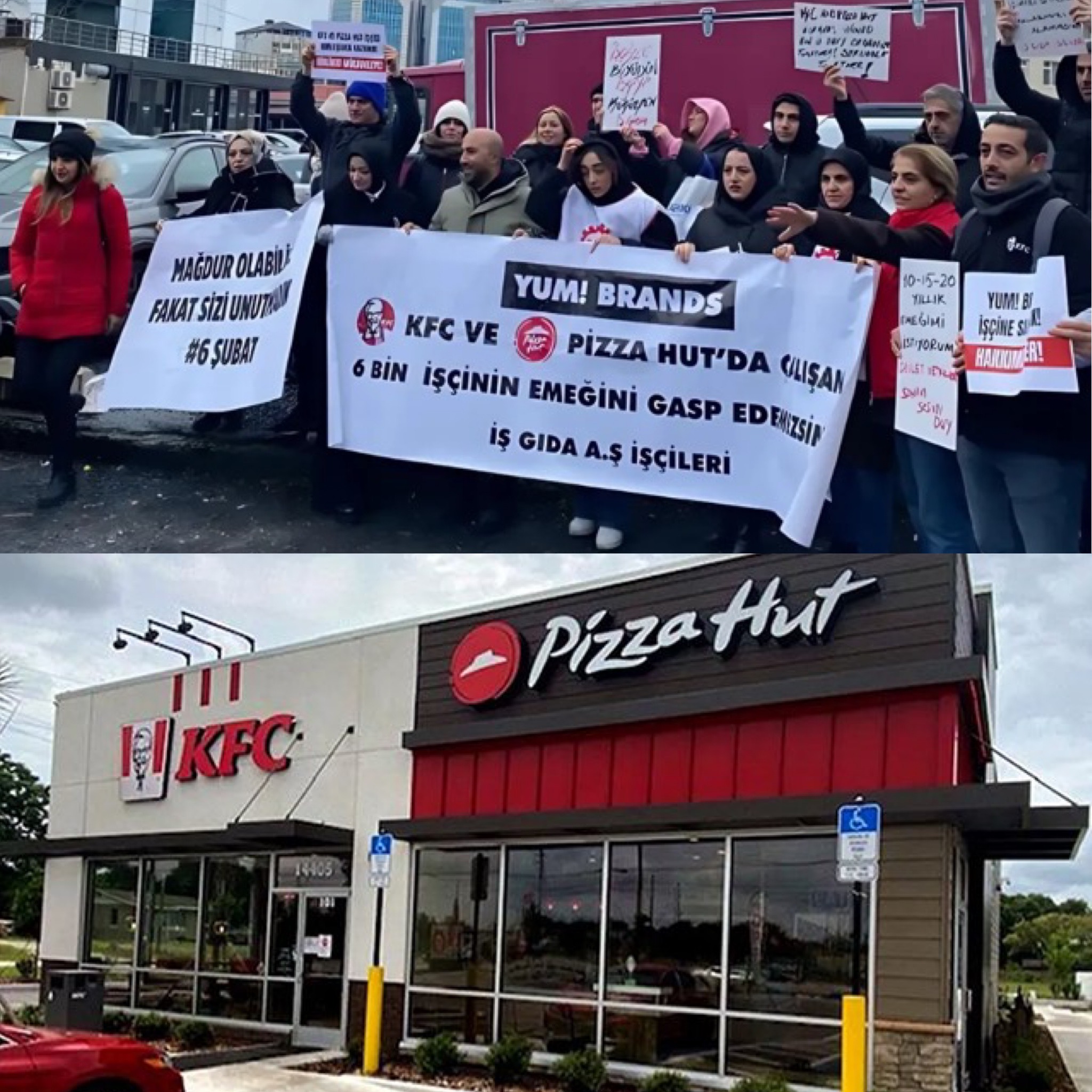
When business was good, İş Gıda didn’t have many problems with its employees. However, when things went south, many employees experienced delayed payments. The company, which filed for bankruptcy, faced financial difficulties, putting the salaries and severance pay of approximately 7,000 employees in jeopardy. From what I understand, a settlement was reached with the employees, with a percentage of the salaries and severance pay paid. (See: https://www.yurtgazetesi.com.tr/guncel/kfc-ve-pizza-hut-iscilerden-konkordato-eylemi-7-bin-kisi-issiz-kalacak-25-h260961.html)
Location assessment errors
There were also errors made at the restaurant level. For example, they closed the profitable Pizza Hut in Bahçelievler and converted it into a KFC. Good governance doesn’t require a waste of money, closing a profitable restaurant and converting it to another brand. If you’re confident in your location, you’d open another KFC nearby. Having the two together, in close proximity, always creates synergy.
It’s also said that serious mistakes were made in some of the locations that opened. Some of the restaurants that opened so quickly and without due diligence were persistently kept in the system despite not doing any business at all.
From what I’ve learned, during this time, İş Gıda also acquired the franchise rights for Pizza Huts in Germany. While its Turkish operations were experiencing serious difficulties, I believe the source of the problem lies in the fact that it acquired a franchise in another country and directed its investments there. I’ve even heard rumors that money was being smuggled abroad. However, it wouldn’t be appropriate to comment without proof of such a situation.
Untimely Foreign Investments
I don’t know the source of the financing obtained by İş Gıda or even İş Holding, which owns it, or how they managed their financial planning, but based on the results, I can say they made serious mistakes.
You can view the investments of İş Holding, owner of İş Gıda, at https://www.isholding.com/. Here, we see that they invested in many different sectors, including Peyman, a dried fruit and nut retailer.
Of course, I can’t comment fully because I’m not involved with the company, but you wouldn’t divert your financial resources to other companies or another Pizza Hut franchise abroad while KFC and Pizza Hut were experiencing serious payment problems. These brands are valuable, and Turkent A.Ş. should prioritize them. You invest in improving the operations of a company with significant turnover, such as İş Gıda, and helping it regain its financial strength. You don’t spend your money on other endeavors and transfer it abroad.
Name Similarity with İş Bankası
When I first heard the names İş Gıda and İş Holding, I was confused. I wondered, “Is İş Bankası behind these companies?” Their names strongly suggest they are “İş Bankası companies.” As you know, İş Bankası has made dozens of investments and owns numerous companies. I’m curious to see what the relevant executives of İş Bankası, founded by Atatürk, who always valued reputation and long-term relationships, think about this similarity in name.
Let’s take a look at the process that followed İş Gıda’s declaration of bankruptcy at the beginning of this year. As far as I can tell, 547 stores have closed. The company declared bankruptcy, and a trustee was appointed. The aim of this trusteeship was to provide the company with as much cash as possible, ensure maximum debt repayment, and mitigate losses. I’d like to share the figure I heard with you to help you visualize the appointment of the trustee: 7.7 billion TL in debt has been transferred. Unfortunately, I’ve heard that they sold 120 stores, including all their equipment, to KFC’s biggest rival, Popeye’s. Negotiations are ongoing to sell similar stores to other KFC competitors. This is completely unacceptable, and if they’re selling stores to KFC’s competitors in this manner, it deeply disturbs me, someone who has dedicated significant time to the brands. Yum’s executives also need to deeply understand this fiasco and take necessary precautions. I’ll address this issue in my proposal for how KFC and Pizza Hut can recover in Turkey.
Efforts to Close on the Cheap
Among the difficulties being faced, I’ve also heard that İş Gıda is unable to pay its franchise fees. In fact, I believe this was the main reason for securing the franchise rights from İş Gıda. The issue of paying franchise fees has always been a red flag for Yum.
I also heard that the former country manager, the then-President of KFC Global, was aware of İş Gıda’s situation and the difficulties it was experiencing. So, as I suspected, the franchise rights weren’t taken from İş Gıda and the stores were closed overnight. These incidents came to light a year or two before all the restaurants were closed at the beginning of this year. Of course, I think covering these incidents up, managing them for a while, and trying to fix them are typical reactions during this period. I’d also like to share another rumor with you. At the end of this whole process, the CEO and former general manager of KFC Global, who were on duty at the time, pressured İş Gıda to reclaim Turkey, trying to close it down cheaply. When İş Gıda refused to offer the restaurants at a low price, the franchise agreement was canceled. This is, of course, a rumor I’ve heard. Knowing the attitudes of those within, it seems incredibly plausible to me.
The person who made the mistakes is no longer in charge.
In fact, when they couldn’t get out of this situation, when the entire system ground to a halt and began to cause significant damage to Yum, Yum pulled the plug. However, all these events also led to another consequence. This was the dismissal of the former general manager of KFC Global in Turkey, who was appointed CEO of KFC Global in January 2022, following the fiasco in Turkey this year.
So, naturally, the Pakistani-born individual who organized this entire process, who managed the company in Turkey from the beginning, then selected and managed the franchises, and was fully aware of everything, lost his job a few months ago because it was perceived that a significant market like Turkey had been lost and that Yum’s international reputation had been seriously damaged. He is no longer CEO of Global.
Americans finally saw the truth when the company went bankrupt. Of course, their inability to see the full picture stems from the fact that deep-rooted problems were swept under the rug. We call this “good morning after supper” in English. It’s like saying “good morning after dinner.” They were too late to act.
Let me share with you the process that followed the company’s bankruptcy and the appointment of a trustee. They chose HD Holding, the industry-renowned company that owns the HD İskender, Pidem, and Makarna brands, as their new franchise. I believe HD Holding acquired a certain number of franchises when they entered the business. After the trustee’s departure, they allocated some important franchises in Istanbul, Ankara, and Izmir to reopen.
Meanwhile, they contracted with two or three consulting firms to manage leases and resolve issues, particularly with shopping malls. These firms have a serious business. It’s easy to say that 547 stores have closed. I don’t know how many of them are located in shopping malls, but each restaurant is a business in itself.
Mistakes That Led to the Bankruptcy of KFC and Pizza Hut
1) Mistakes Made by YUM
a) Lack of operational knowledge: Despite having its own brands, Yum, having always grown through franchises, became disconnected from operations over time. In other words, the number of Yum managers who truly had a grasp of operations has decreased significantly over the years. Managers who knew operations were gradually replaced by those who didn’t understand operations (or pretended to). A significant number of them compromised the company’s principles of “customer satisfaction” and “producing high-quality and delicious products.” This, in turn, led to the company becoming disconnected from reality. They appointed someone who didn’t understand operations (but pretended to), and this person, in turn, lost touch with the field when he dismissed managers who knew operations well in Turkey because they were close to the previous franchise owners. He began operating independently, and thus remained largely passive in the field.
b) Ignorance of Country: Americans generally don’t understand the cultures of different countries. When they think they don’t understand, they appoint someone who does, based on their own understanding. Appointing a Pakistani country manager to Turkey demonstrates their complete lack of understanding of the region. Unfortunately, a significant majority of American companies make these kinds of mistakes. They say, “So what? This guy comes from a region close to that region; he’ll do the job properly.” But where is Pakistan and where is Turkey? The cultures are vastly different. While there are plenty of skilled, experienced, and operationally savvy professionals in Turkey who could do this job properly, Yum’s management chose to appoint someone close to them as head of the Turkish market. They acted to satisfy their own ambitions. None of the models they tried were successful, and they effectively bankrupted the operation in a significant country like Turkey, along with hundreds of restaurants.
c) Company ego overruling logic: Acting out of spite for the previous franchise owner, Süzer Holding, was a grave mistake. Putting aside the disloyalty displayed here (we’re talking about a franchise that has served the brands for 24 years), what were the faults of the professionals who did their jobs properly back home?
d) Wrong franchise selection: Initially, Saudi Arabs unfamiliar with Turkey were granted franchises to a fund based in the United Arab Emirates. After the problems they experienced, they granted franchises for two brands to a Turkish company I’d never heard of. I’m having difficulty understanding the logic and reasoning behind this franchising decision.
e) Lack of oversight and transparency: I heard that there was a lack of oversight and transparency when I was managing İş Gıda as a franchisee at Global. This was also documented as part of the poor management displayed during the process.
f) Constantly pressuring us to open restaurants: During our franchise period, Yum was constantly pressuring us to open more restaurants. They wanted to interfere in everything, and we always corrected them by reminding them of the realities of the country and managing the process as it should be, not as they wanted. However, this behavior, which sometimes escalated into mobbing, seriously drained our energy. They also managed us from Dubai. We were deeply disturbed by the disrespectful behavior of some of the managers there. We warned them repeatedly to correct their behavior. We repeatedly said, “Take us to Europe. As Turkey, we are closer to the European mentality than the Middle East,” but they didn’t listen. They persistently continued to keep us from the United Arab Emirates. I believe the franchises that followed us went through similar processes. They never understood that this negative behavior, applied like a bludgeoning attempt, served no purpose other than to incite franchisees to make mistakes rather than to motivate them. We repeatedly warned them harshly, but they never changed this mindset.
2) Mistakes Made by İş Gıda
a) Diverting Resources to Other Businesses and Countries: This is the biggest mistake. To do justice to valuable brands like KFC and Pizza Hut, resources shouldn’t have been allocated. İş Gıda could have grown the company in Turkey and sold it as we did. Instead of focusing on this strategy, they expanded the restaurant business while simultaneously expanding their business and expanding into other countries. When they diverted resources, they were unable to solve numerous cash-demanding problems, from the inability to pay suppliers to the depletion of resources.
More specifically, investments in other companies like Peyman and other countries like Germany weakened KFC and Pizza Hut Turkey. Had these companies been financially focused, this rupture might not have occurred. There are also rumors that money was being diverted abroad, but it wouldn’t be appropriate for me to comment on this. Talking about something unproven is speculation.
b) Failure to make timely payments to suppliers: This is another huge mistake. Suppliers always come first. If you can’t get a product, you can’t have a product. You can always negotiate with franchisees regarding negotiations or payment terms, but you must pay your suppliers according to the terms you promised. Instead of investing in other companies or countries, they should have provided financing to the company and resolved this supply problem.
c) Unplanned Growth: Due to both Yum’s constant boza brewing on their backs and the Turkish company’s excessively ambitious and unplanned growth, the company is mired in debt. In a constantly growing organization, opening a restaurant before the team is ready is a huge mistake. Unfortunately, emotions have trumped logic in this situation.
d) Failure to resist the constant pressure to open restaurants: İş Gıda should have resisted Yum’s almost bullying pressure to open restaurants to a certain extent and invited everyone to follow reason. Sometimes, when both sides are ambitious, logic disappears. Then, you end up opening a multitude of restaurants that remain vacant simply for the sake of opening. Opening inefficient stores leads to unnecessary waste of resources and significant damage to the company.
What needs to be done to restore the strength of the KFC and Pizza Hut brands?
1) What Yum needs to do:
a) Full support to their franchisee: They need to treat HD, their franchisee, well and provide full support. Incidentally, I believe HD is the right choice. Yum is ultimately awarding a franchise to the right company among the franchise candidates it could have chosen. It needs to carefully consider this and ensure that everything is done through consensus, rather than adopting the dictatorial management style it used to use. In other words, if Yum has an idea and HD disagrees, it shouldn’t be obligated to do so. They need to trust their franchisees nationwide and act collaboratively, not dictate.
b) The Pizza Hut problem: KFC is easier to recover from this period. Pizza Hut needs to develop a plan that will literally revive the brand. I have some ideas for this. I won’t share them here to avoid tipping off competitors. If any sensible executives from Yum or HD contact me, I’ll share them with them.
c) Bringing Taco Bell to Turkey: In an environment where everyone is talking negatively about brands, Yum’s surprise announcement that they plan to bring Taco Bell to Turkey would be a positive shock. This is the kind of resolve that’s needed. With this action, they need to send the following message to the Turkish public: “We’ve made mistakes in the past, and we admit it. However, we’ve also had good times in the past, and our brands/products have been very popular in Turkey. Turkey is a very valuable country to us. It’s heartbreaking to see us regress in this way. Therefore, in addition to our valuable brands like KFC and Pizza Hut, we aim to bring our third valuable brand, Taco Bell, to Turkey. We’re opening our first Taco Bell store on the following date.”
The communication of such a surprise decision would excite the public in Turkey. The image of a brand, which had been viewed with such hostility and negativity, was completely reversed. Turks are emotional people. They can slam someone in one moment, only to later, if satisfied, make a sudden change of heart and boost that same person or organization (or vice versa). Therefore, Taco Bell, a brand that suits Turkish tastes and is viewed with great affection by Turks, is making a splash in Turkey. This momentum will also put KFC and Pizza Hut on the path to recovery.
Meanwhile, whether Yum franchises the Tex-Mex (Texas-Mex) Taco Bell or opens it themselves, it doesn’t matter. They must somehow bring the Taco Bell chain to Turkey and rally the public behind them.
2) What HD needs to do:
a) Hire the right managers and professionals: They need to build a strong team. I especially recommend considering those who have achieved success during the Süzer Holding era. They should also create a robust internal training program and train their own professionals.
b) Focus on KFC and Pizza Hut: HD also has valuable brands. However, as you will appreciate, KFC and Pizza Hut are valuable brands that have proven themselves globally. They should recognize this value and prioritize their importance. They should focus both time and money on these brands and strive to bring them to the top. They will reap the rewards in the long run.
3) What both companies should do:
a) Repurchase restaurants currently under receivership: It is unacceptable for receivership to sell closed restaurants to KFC competitors, especially Popeye’s. Yum and HD need to work together to prevent this. HD can acquire a certain number of stores within its own power and capacity. However, Yum should also print the money and buy the good stores, operate them for a period of time, and then return them to HD in exchange for cash. In other words, I believe at least half of the 547 closed stores are good ones. Yum needs to fork over the cash and buy back the best of these and prevent them from falling into the hands of its biggest competitors.
b) Brands should develop robust comeback campaigns: When KFC and Pizza Hut reopen, they should announce it with a very different and robust campaign. The beginning of this comeback story is crucial. It generally continues as you begin. Yum should fully support these restaurants’ reopening campaigns alongside HD. I even think Yum could allocate a marketing budget to this. Don’t leave your new franchise alone in this. Let them develop a great marketing campaign together. Let everyone in Turkey hear about it.
I hope the relevant people learn from what I’ve written and that they will revive valuable brands like KFC and Pizza Hut with the support of HD Gıda and Yum.
I wish you success in this new season.